
The Netherlands is known for its cycling culture, efficient public transport and well-maintained roads. However, renting a car or driving your own vehicle can be a convenient way to explore the country, especially if you want to visit smaller towns, rural areas or destinations outside the major cities.

If you're planning a trip to the Netherlands, you might be wondering: can tourists drive in the Netherlands with a foreign driving licence? Do you need an International Driving Permit? And are there any specific traffic rules you should be aware of?
The good news is that many tourists can legally drive in the Netherlands using their existing driving licence. However, the exact requirements depend on where your licence was issued, whether it is still valid and how long you intend to stay in the Netherlands.
In this blog, we explain everything tourists need to know about driving in the Netherlands, from foreign driving licence requirements and essential documents to speed limits, road signs and common traffic situations.
Can you drive in the Netherlands with a foreign driving licence?
Yes, tourists can generally drive in the Netherlands with a valid foreign driving licence. According to the Netherlands Vehicle Authority (RDW), visitors who do not live in the Netherlands can use their foreign driving licence during a tourist visit.
However, the exact requirements depend on the country where your driving licence was issued.
Driving with an EU or EFTA driving licence
If your driving licence was issued by a country within the European Union (EU) or the European Free Trade Association (EFTA), you can generally use it in the Netherlands without applying for a Dutch driving licence.
Tourists from countries such as Germany, Belgium, France, Spain and Italy can drive using their existing driving licences, provided they are valid and cover the type of vehicle they intend to drive.
With a valid EU or EFTA driving licence, you normally do not need an International Driving Permit.
Driving with a non-EU driving licence
Tourists from countries outside the EU and EFTA can also drive in the Netherlands with a valid foreign driving licence.
This includes visitors from countries such as the United States, the United Kingdom, Canada, Australia and India. However, depending on where the licence was issued and its format, carrying an International Driving Permit may be advisable.
The RDW recommends that driving licences issued outside the EU and EFTA use the internationally recognised vehicle categories A, B, C, D and E. If your licence uses different category designations, an International Driving Permit is recommended.
Do tourists need an International Driving Permit in the Netherlands?
An International Driving Permit (IDP) is a document that provides a standardised translation of your national driving licence. This makes it easier for foreign authorities and car rental companies to check which vehicles you are authorised to drive.
Not every tourist needs an International Driving Permit. Visitors with a valid EU driving licence, for example, generally do not need one. American tourists can also usually drive in the Netherlands without an International Driving Permit during a short visit.
However, an International Driving Permit can be useful if your national driving licence does not use internationally recognised vehicle categories or is difficult for Dutch authorities to understand.
It is important to know that an International Driving Permit does not replace your original driving licence. When an International Driving Permit is required, you must carry both documents.
Before travelling to the Netherlands, check the requirements with the RDW and your car rental company. Rental companies may have additional requirements.
What documents do you need to drive in the Netherlands?
Before getting behind the wheel, it is important to check that you have all the necessary documents with you. This is especially relevant if you plan to rent a car or travel through several European countries in your own vehicle.
Make sure you have the following documents:
- A valid driving licence: Your licence must be valid and authorise you to drive the vehicle in question.
- An International Driving Permit, if required: You must be able to present this document together with your original driving licence.
- A passport or valid identification document: This may be required when renting a car or during an identity check.
- Vehicle registration documents: These must be available when required, especially if you are driving your own car.
- Valid car insurance: Check that the vehicle has the mandatory insurance coverage.
If you rent a car, the rental company will usually arrange the mandatory car insurance. However, check which coverage is included in your rental agreement and whether additional insurance is necessary.
What are the traffic rules in the Netherlands?
Although Dutch traffic rules are similar to those in many other European countries, there are some important differences that tourists should be aware of.
From speed limits and priority rules to cycle paths and roundabouts, knowing what to expect can help you avoid dangerous situations.
1. Drive on the right-hand side of the road
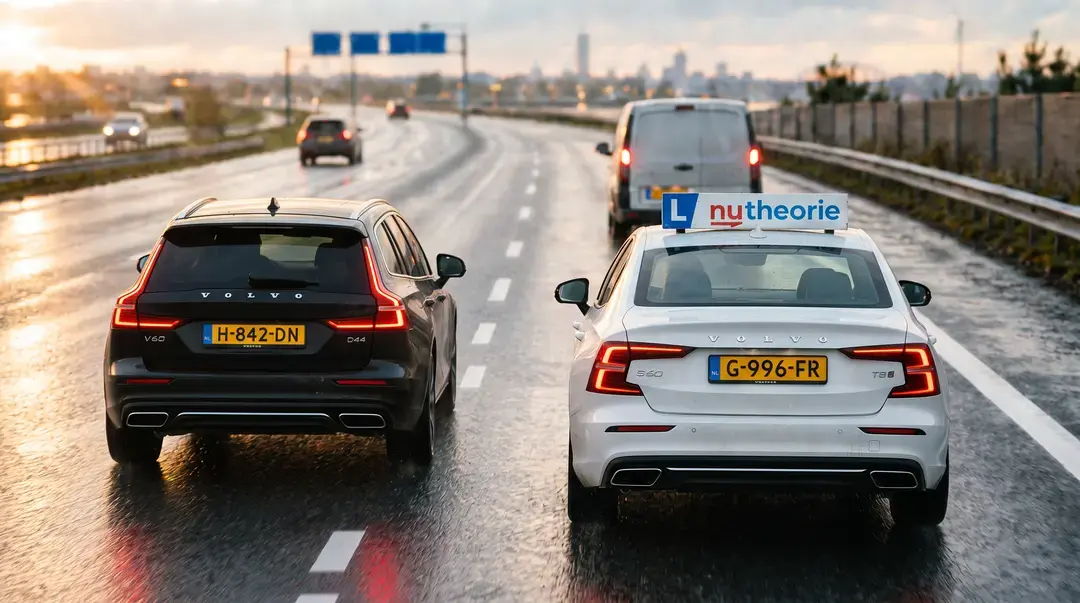
In the Netherlands, all vehicles drive on the right-hand side of the road. Overtaking is generally done on the left, and drivers must return to the right-hand lane as soon as it is safe to do so.
This can take some getting used to if you come from a country where people drive on the left, such as the United Kingdom or Australia.
Pay extra attention when entering roundabouts, turning at intersections or leaving parking areas.
2. Follow the Dutch speed limits
The maximum speed limit in the Netherlands depends on the type of road, the location and the applicable traffic signs. For passenger cars, the general speed limit within built-up areas is 50 km/h, while outside built-up areas it is usually 80 km/h. On expressways, the speed limit is generally 100 km/h. On motorways, the maximum speed limit may be 100, 120 or 130 km/h, depending on the road and time of day.
One important rule concerns Dutch motorways. On many motorways, a maximum speed limit of 100 km/h applies between 06:00 and 19:00, even when a higher speed is permitted in the evening or at night.
Some roads have lower speed limits, such as 30 km/h in residential areas. Always pay attention to traffic signs and electronic speed displays rather than assuming that the general speed limit applies.
3. Pay close attention to cyclists
Cycling is an important part of everyday life in the Netherlands. As a result, drivers regularly encounter cyclists at intersections, roundabouts and crossings.
Many roads have separate cycle paths, often recognisable by their red surface. However, on some roads, cyclists and motor vehicles share the same carriageway.
When driving, always check for approaching cyclists before turning, changing direction or opening your car door. Remember that cyclists do not automatically have priority in every situation. Who has priority depends on the road layout, traffic signs, road markings and applicable traffic rules.
4. Understand priority rules at intersections
An important Dutch traffic rule is that drivers at intersections of equal priority must generally give way to drivers approaching from the right.
However, there are exceptions. Traffic signs, road markings, traffic lights and the type of road can determine who has priority.
For example, if you approach an intersection with triangular give-way markings on the road, commonly known as shark teeth (haaientanden), you must give way to traffic on the intersecting road.
It is important to approach unfamiliar intersections carefully and watch for cyclists, pedestrians and other vehicles before continuing.
5. Know how roundabouts work
Roundabouts are common in the Netherlands. You may encounter several during even a short drive.
At many Dutch roundabouts, traffic already circulating has priority because drivers entering the roundabout must give way according to the traffic signs and road markings. However, this does not apply to every roundabout. Always check the priority signs before entering.
Also pay close attention to cyclists using cycle paths around the roundabout. Their priority may differ depending on the roundabout's layout.
Use your indicator when leaving the roundabout and carefully check for other road users.
6. Do not hold your phone while driving
In the Netherlands, it is prohibited to hold a mobile phone or another mobile electronic device while driving.
You may use navigation or make hands-free calls, provided you remain focused on the road. If you need to change your route or enter a new destination, it is advisable to stop in a safe and permitted location first.
7. Be aware of the alcohol limit
The Netherlands has strict rules regarding alcohol consumption and driving.
For experienced drivers, the maximum permitted blood alcohol concentration is 0.5‰. For novice drivers, a lower limit of 0.2‰ applies.
These rules also apply to tourists with foreign driving licences. If you plan to drive, the safest option is to avoid alcohol completely.
Can tourists rent a car in the Netherlands?
Yes, tourists can rent a car in the Netherlands as long as they meet the rental company's requirements.
Most rental companies have a minimum age requirement of 21, although some accept younger drivers. Certain vehicle categories may have a higher minimum age requirement. Drivers under 25 may also have to pay an additional fee.
Generally, you will need a valid driving licence, an identification document and a payment card accepted by the rental company. Some rental companies also require you to have held your driving licence for at least one year.
Always check the rental conditions before making a reservation. Make sure you understand which insurance policies are included, what the fuel policy is, whether mileage restrictions apply and which additional charges may be involved.
Is driving in the Netherlands difficult for tourists?
Driving in the Netherlands is generally manageable for tourists. The roads are well maintained, and traffic signs are usually clearly displayed.
However, certain traffic situations may be unfamiliar if you have never driven in the Netherlands before.
Busy city centres can be particularly challenging. In cities such as Amsterdam, Utrecht and Rotterdam, drivers must constantly pay attention to cyclists, trams, pedestrians and traffic restrictions.
Some streets are only accessible to vehicles with a permit, while other locations have parking restrictions or specific access rules.
If you are unfamiliar with Dutch roads, it is advisable to plan your route in advance and avoid busy city centres during rush hour whenever possible.
What should tourists know about parking in the Netherlands?
Parking is another important consideration when driving in the Netherlands, especially in larger cities.
Many urban areas have paid parking zones. Parking fees can vary significantly depending on the location. In some places, you can pay using a parking machine or a mobile parking app.
You may also encounter blue parking zones, where parking is permitted for a limited time using a parking disc. Always check the traffic signs to see which restrictions apply.
If you are visiting a busy city, a Park and Ride (P+R) facility can be a convenient option. You can park your car outside the city centre and continue your journey using public transport.
Before leaving your car, always check whether parking is permitted and whether payment or a parking permit is required.
What if you decide to move to the Netherlands?
Different rules apply to tourists and people who officially become residents of the Netherlands.
If you move to the Netherlands, the period during which you can continue using your foreign driving licence depends on the country where it was issued.
Residents with a valid driving licence from an EU or EFTA country can generally continue using it for a longer period, depending on specific conditions.
For residents with a driving licence issued outside the EU or EFTA, a period of 185 days generally applies after becoming a resident of the Netherlands. After this period, a Dutch driving licence is usually required.
Depending on the country where your licence was issued and your personal circumstances, you may be able to exchange your foreign driving licence for a Dutch driving licence.
If exchanging your licence is not possible, you may need to pass both the Dutch theory test and the practical driving test to obtain a Dutch driving licence.
For international residents preparing to obtain a Dutch driving licence, understanding local traffic rules is an important first step. A structured theory course can help you become familiar with Dutch road signs, priority rules and traffic situations before taking the official CBR theory test.
Conclusion
Tourists can generally drive in the Netherlands with a valid foreign driving licence, whether they come from another European country or from outside Europe. However, depending on where your licence was issued, an International Driving Permit may be necessary or advisable.
Before travelling, check whether your driving licence is accepted in the Netherlands, review your car rental company's requirements and familiarise yourself with Dutch traffic rules. Pay particular attention to cyclists, priority rules, speed limits and parking restrictions. These are some of the most important aspects of driving in the Netherlands.
With the right preparation and knowledge of local traffic rules, you can explore the Netherlands safely and comfortably by car.