.jpg)

Many learner drivers find a supplementary sign under a traffic sign confusing during the theory exam. However, understanding these signs is very important because they provide additional information about how a traffic sign should be interpreted. Misunderstanding a supplementary sign can easily lead to answering a theory exam question incorrectly.

A supplementary sign under a traffic sign gives extra details about the rule shown on the main sign. This can include information about the distance at which the rule starts, how long the rule applies, or during which hours the rule is valid. Because theory exam questions often combine multiple signs and supplementary signs, it is essential to carefully read every sign together.
In this article, we explain how a supplementary sign under a traffic sign works and go through several realistic theory exam examples so you can better understand how to interpret them.
Distance on a Supplementary Sign Under a Traffic Sign
Sometimes you will see a supplementary sign under a traffic sign that only shows a distance, such as “500 m.” When a distance appears on the sign without arrows, it means that the traffic rule shown on the main sign does not apply immediately. Instead, the rule will only start at the distance indicated on the supplementary sign.
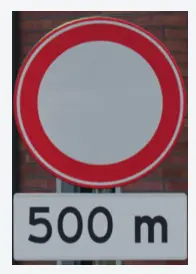
For example, imagine a traffic sign indicating no entry from either direction, with a supplementary sign under the traffic sign showing 500 meters. These signs together mean that in 500 meters it becomes forbidden to enter from either direction. The restriction does not apply yet because the distance on the supplementary sign indicates where the rule will start.
If you were asked in a theory exam whether you are allowed to enter the road at that moment, the correct answer would be yes, because the restriction only begins further ahead. Even though the road will be closed in 500 meters, the rule does not apply at your current position.
Supplementary Sign With Two Black Arrows
Another type of supplementary sign under a traffic sign shows a distance between two black arrows. This type of sign has a different meaning compared to a sign that only shows a distance.
When a distance is displayed between two arrows, the rule shown on the main traffic sign starts immediately and continues for the distance shown on the sign. Once that distance has passed, the rule no longer applies.
It is also important to remember that a white supplementary sign under a traffic sign only applies to the sign directly above it. Traffic signs without a supplementary sign underneath apply on their own and are not limited by additional conditions.
Theory Exam Example: Two Lanes
Let’s look at a typical theory exam question that involves a supplementary sign under a traffic sign.
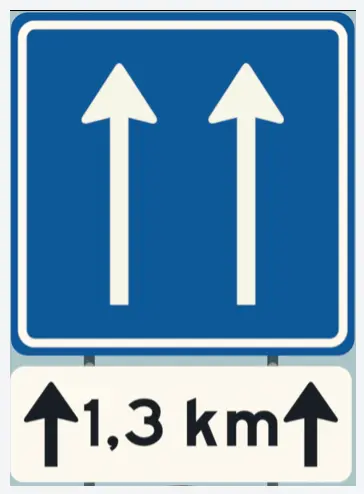
The question asks: When can you expect two lanes? The possible answers are:
A. From now until 1.3 km
B. Only after 1.3 km
The main traffic sign indicates that there are two lanes, and the supplementary sign under the traffic sign shows 1.3 km between two arrows. Because the arrows indicate the beginning and the end of the situation, the meaning is that the two-lane section starts immediately and continues for 1.3 kilometers.
In this situation, the correct answer is A: from now until 1.3 km. The additional lane begins at the location of the sign and remains in effect for the distance shown on the supplementary sign.
Supplementary Sign: A More Difficult Theory Exam Question
Now let’s look at a more challenging example that includes multiple signs and a supplementary sign under a traffic sign.
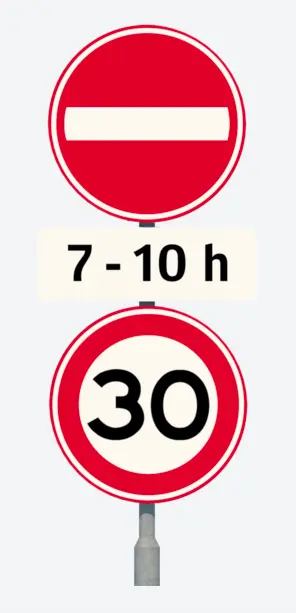
Imagine a situation where the top sign indicates no entry, and the supplementary sign under the traffic sign shows the time 07:00 – 10:00. Beneath that sign there is also another sign indicating a maximum speed of 30 km/h. The theory exam question states that the current time is 11:00, and you are asked whether you are allowed to enter the road at 40 km/h.
The supplementary sign under the traffic sign shows that the no-entry rule only applies between 07:00 and 10:00. Because the time is now 11:00, the restriction no longer applies and you are allowed to enter the road. However, the speed limit sign of 30 km/h still applies, meaning that driving at 40 km/h would not be allowed.
This example shows why it is important to carefully analyze every sign and supplementary sign together. The theory exam often tests whether you notice these details and interpret them correctly.
Conclusion
Understanding how a supplementary sign under a traffic sign works is essential for successfully passing the theory exam. These signs often provide important details about when a rule starts, how long it applies, or under which conditions the rule is valid. Because exam questions frequently combine multiple signs, missing one small sign can easily lead to the wrong answer.
By practicing these types of situations and learning how to read every sign carefully, you can avoid common mistakes and approach the theory exam with much more confidence.
If you want to be fully prepared for your theory exam, following a structured theory course can help you understand traffic rules step by step. With the right preparation, you will be able to recognize tricky exam situations and improve your chances of passing on your first attempt.