.jpg)

Getting your motorcycle licence is an exciting step towards more freedom on the road. An important part of this process is the AVB exam: the Vehicle Control Test. This exam forms the foundation of safe motorcycling and tests whether you can properly control the motorcycle in different situations.

Before you can take the on-road practical exam (AVD), you must first pass the AVB exam. During this test, you demonstrate that you can control the motorcycle at both low and higher speeds and that you can brake and manoeuvre safely.
In this guide, we explain how the AVB exam works, which exercises you can expect, and provide useful tips to help you prepare successfully.
What Is the AVB Motorcycle Exam?
The AVB exam takes place on a closed practice area and focuses entirely on motorcycle control. During the exam, the examiner assesses how well you can handle the motorcycle in different practical situations.
The exam consists of twelve possible exercises divided into four clusters:
- Walking with the motorcycle
- Slow-speed exercises
- High-speed exercises
- Braking exercises
During the exam, you perform seven exercises. To pass, you must complete at least five exercises successfully. In addition, you must pass at least one exercise from each cluster.
Cluster 1: Walking with the Motorcycle
This cluster tests how well you can move the motorcycle when you are not riding it. This is important for parking and manoeuvring in small spaces.
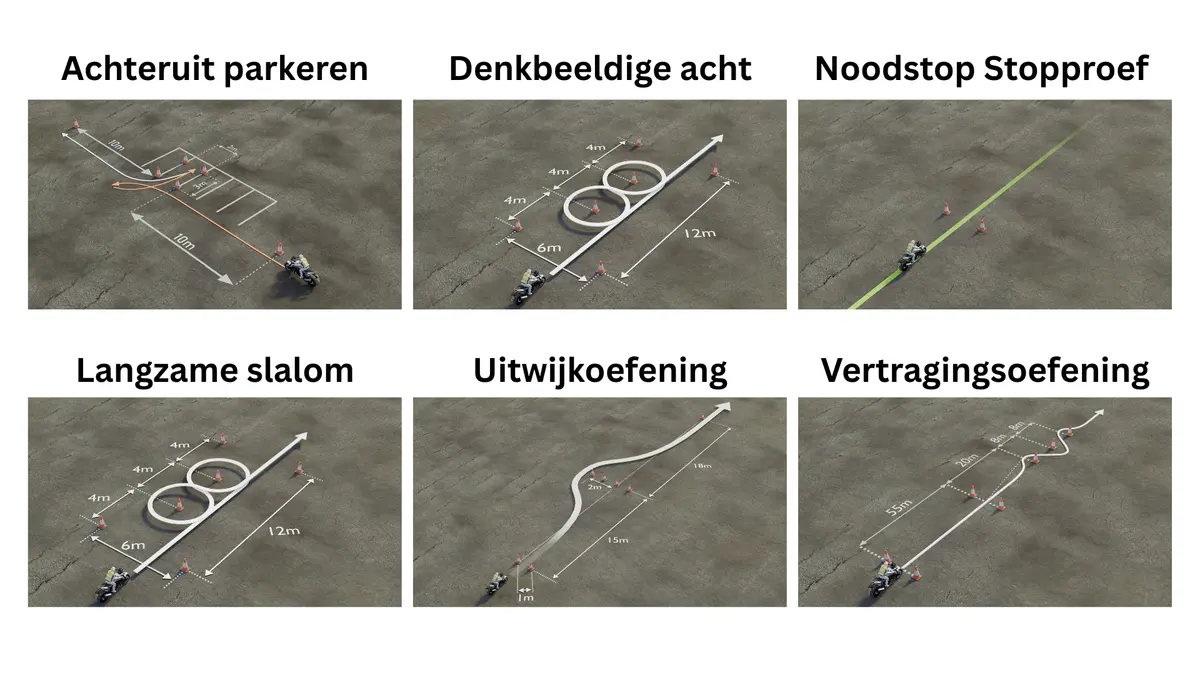
Reverse Parking (Mandatory)
In this exercise, you walk alongside the motorcycle past an imaginary parking space. You then reverse the motorcycle into the parking space and place it on the stand. Afterwards, you remove the motorcycle from the stand and walk it out of the parking space.
The examiner checks your control, balance, and safe handling.
Cluster 2: Slow-Speed Exercises
The slow-speed exercises focus on balance, control, and precise motorcycle handling at low speed. These skills are important in city traffic and during slow-moving traffic situations.
Slow Slalom (Mandatory)
During the slow slalom, you ride slowly between cones. You use a slipping clutch while keeping the motorcycle stable without placing your feet on the ground.
Good balance and proper vision technique are essential.
Riding Out of a Parking Space
You start from a standstill and ride out of a parking space while immediately making a sharp turn. The examiner assesses how well you control the motorcycle during this manoeuvre.
Figure Eight
In this exercise, you ride a complete figure eight within a rectangular area. This demonstrates your ability to lean and steer the motorcycle smoothly and confidently.
Slow Straight Ride
In this exercise, you ride very slowly next to the walking examiner for a distance of twenty metres. The focus is on balance, motorcycle control, and maintaining a stable speed.
Half Turn
During the half turn, you make a smooth left or right turn within a small marked area. Proper clutch control, rear brake use, and vision technique are important.
Cluster 3: High-Speed Exercises
The high-speed exercises test how well you control the motorcycle at higher speeds.
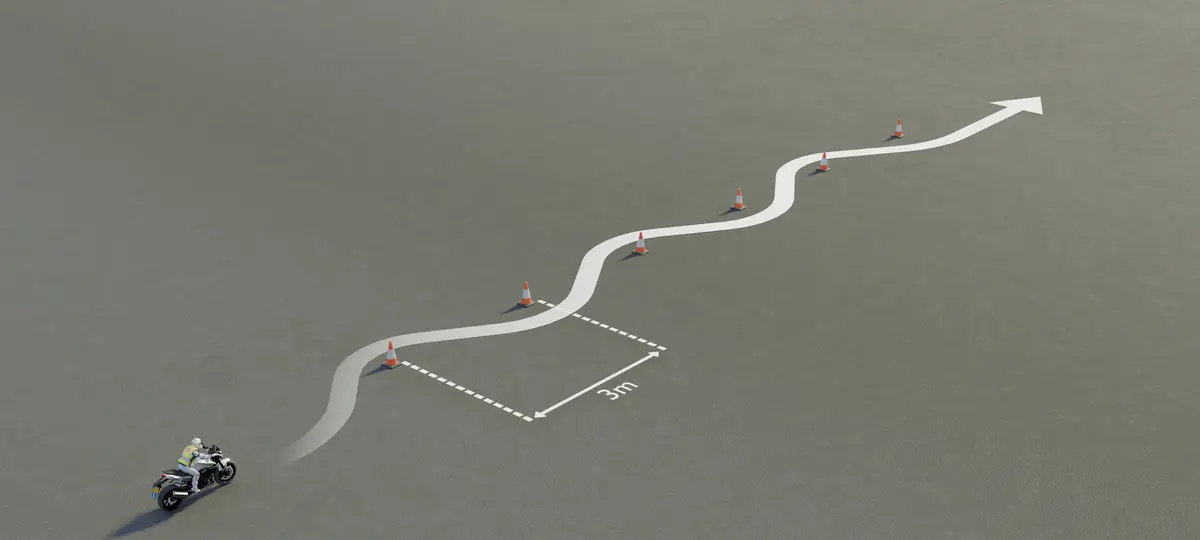
Evasive Manoeuvre (Mandatory)
You ride at approximately fifty kilometres per hour towards an obstacle and then safely swerve around it. The examiner checks whether you can lean the motorcycle safely and remain stable during the manoeuvre.
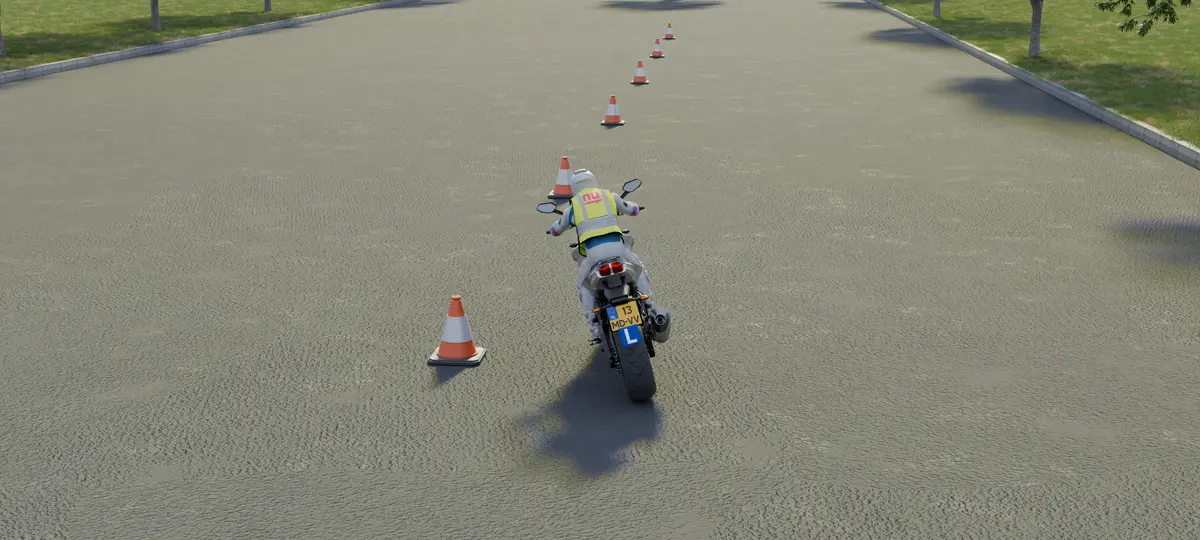
Fast Slalom
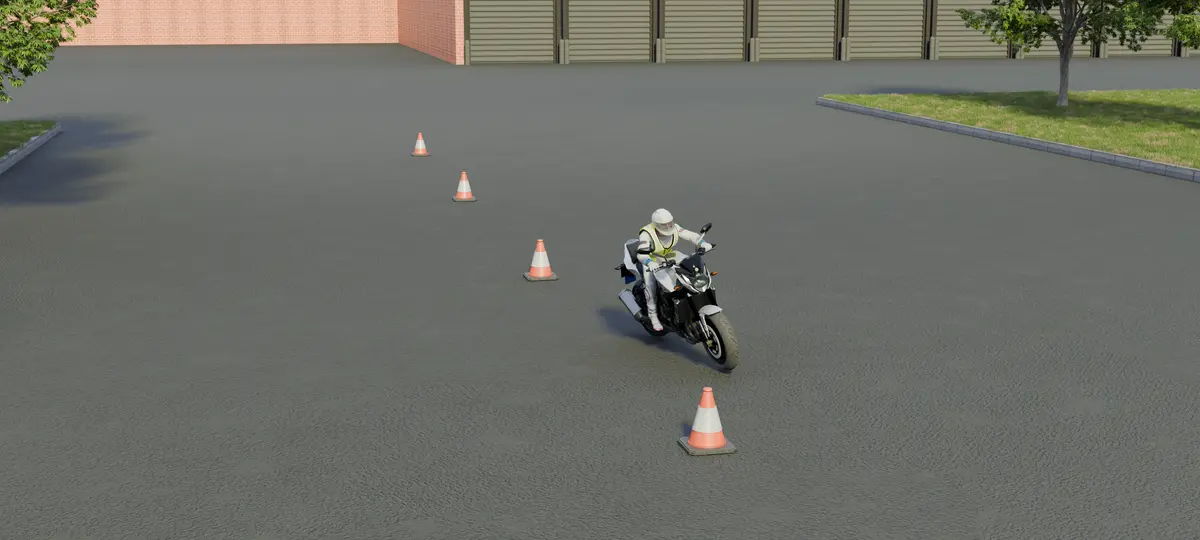
During the fast slalom, you ride through a series of cones at a minimum speed of thirty kilometres per hour. Your movements should be smooth and rhythmic.
Deceleration Exercise
In this exercise, you accelerate to fifty kilometres per hour, brake in a controlled manner, and shift down before entering a slalom. This demonstrates your ability to manage speed and maintain motorcycle control.
Cluster 4: Braking Exercises
The braking exercises focus on safe and controlled braking.
Emergency Stop (Mandatory)
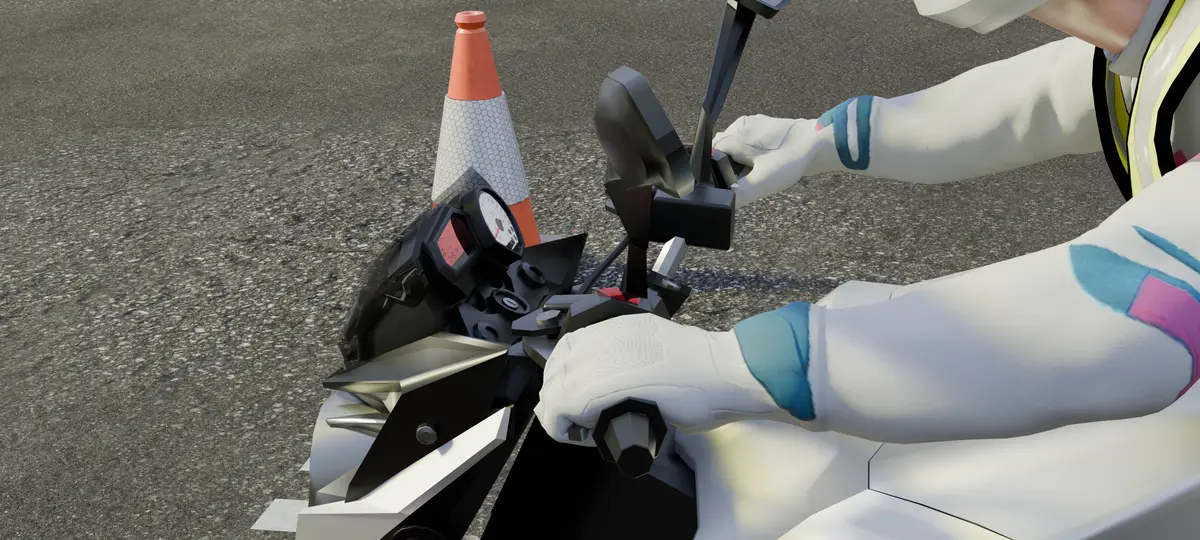
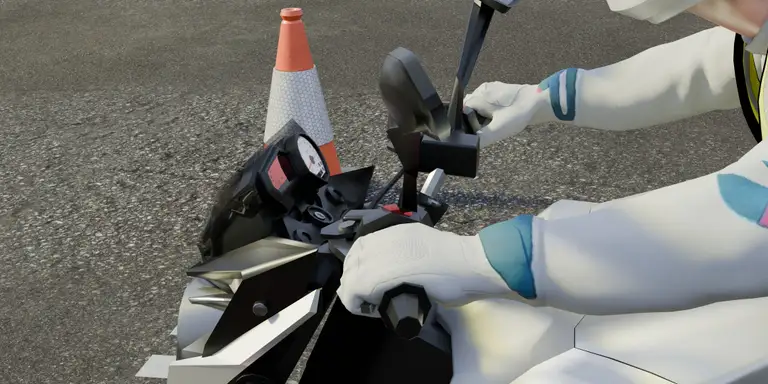
You perform a powerful braking manoeuvre from fifty kilometres per hour and attempt to stop as quickly as possible using both the front and rear brakes.
Precision Stop
In the precision stop, you brake in a controlled way and stop exactly at a designated point.
Stop Test
During the stop test, you brake firmly and shift down to first gear before coming to a complete stop.
How Does the AVB Exam Work?
The AVB exam follows a fixed structure.
1. Introduction and Inspection
Before the exam starts, you meet the examiner. The examiner explains how the AVB exam works and which rules are important during the test. Your motorcycle is also checked to ensure it is technically sound and that you are wearing the correct protective motorcycle gear, such as an approved helmet, gloves, motorcycle jacket, trousers, and sturdy boots.
The examiner also checks whether you can safely and independently handle the motorcycle before the exercises begin. This first moment is often intended to make you feel comfortable and explain what you can expect.
2. Performing the Exercises
During the exam, you perform seven exercises selected by the examiner from the four different clusters. Some exercises are mandatory, such as the slow slalom, evasive manoeuvre, emergency stop, and reverse parking.
The examiner clearly explains which exercise you must perform and where to start. During the exercises, the examiner focuses on several aspects, such as motorcycle control, balance, vision technique, speed, braking, and overall safety.
It is important to perform the exercises calmly and in a controlled manner. Small mistakes are not always a problem as long as you demonstrate safe motorcycle control.
3. Assessment
After each exercise, the examiner evaluates your performance. The examiner checks how well you control the motorcycle and whether you complete the exercise safely and smoothly.
The examiner pays attention to:
- Proper vision technique
- Balance and stability
- Clutch, throttle, and brake control
- Cornering technique
- Overall motorcycle control
- Safety during the exercise
In many cases, you receive brief feedback immediately so you know what went well and which areas may need improvement. It is important to stay focused after a weaker performance and concentrate on the next exercise.
4. Retake Opportunity
If an exercise is marked insufficient, you will usually receive one retake opportunity for that specific exercise. This allows you to recover from nerves or small mistakes made during your first attempt.
During the retake, it is important to stay calm and avoid focusing too much on the earlier mistake. The examiner mainly wants to see whether you can eventually perform the exercise safely and with control.
You do not need to complete every exercise perfectly to pass. Out of the seven exercises, at least five must be sufficient, as long as you pass at least one exercise from each cluster.
5. Results
After all exercises are completed, the examiner discusses the results with you immediately. You will find out right away whether you passed the AVB exam.
If you pass, you may continue to the next stage of the motorcycle licence process: the AVD practical road exam.
If you do not pass, the examiner will usually explain which parts need additional attention. With more practice and experience, you can improve and retake the exam later.
Conclusion
The AVB motorcycle exam is an important step towards obtaining your motorcycle licence. By preparing well, practising the exercises regularly, and staying calm during the exam, you increase your chances of passing on the first attempt.
With enough practice and the right guidance, you can approach the AVB exam with confidence.



.jpg)

.jpg)