

Equal intersections are one of the topics that many candidates find difficult during the CBR theory exam. There are no traffic lights, shark teeth road markings, or priority signs, which means you have to determine who has priority yourself. However, the rules are clear once you know what to look for.

In this guide, we explain step by step how an equal intersection works, which right-of-way rules apply, and how to answer common theory exam questions.
How do you recognise an equal intersection?
An intersection is considered an equal intersection when there are:
- no priority signs;
- no traffic lights;
- no shark teeth road markings.
Because there are no signs or markings that determine priority, the general right-of-way rules apply.
The most important rule: traffic from the right has priority
At an equal intersection, the main rule is:
Drivers approaching from the right have priority.
This means:
- If a driver approaches from your right, you must give way.
- If you are approaching another driver from their right, you have priority.
- If a driver approaches from your left, you generally do not have to give way.
This rule applies to all road users unless another traffic rule takes priority.
Situation: you are driving straight ahead
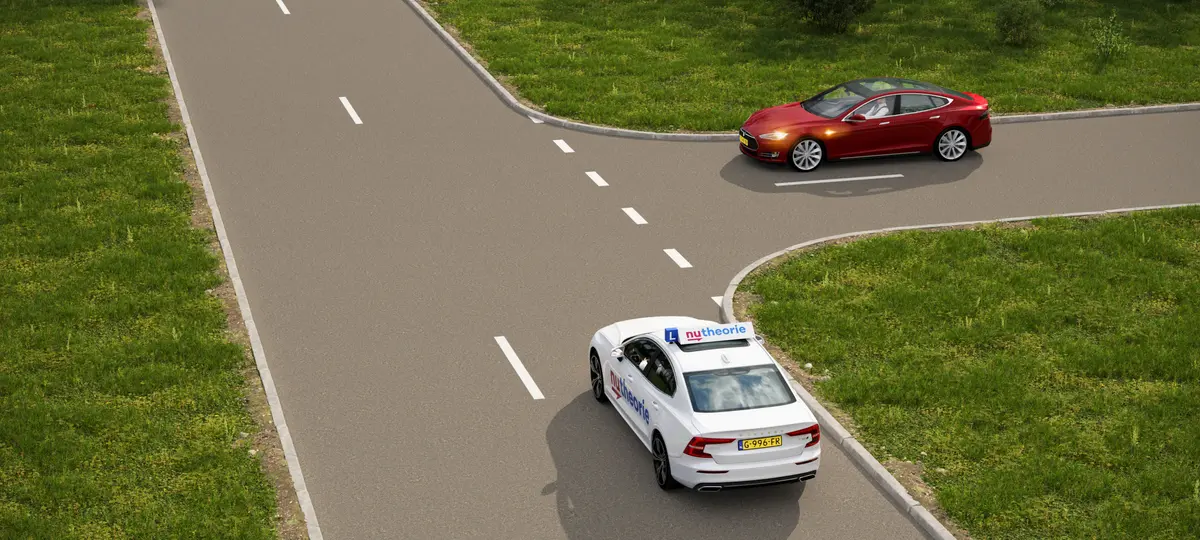
You want to continue straight ahead and a car is approaching from the right.
Although driving straight ahead gives priority in many situations, that rule does not apply here. Because this is an equal intersection, the driver coming from the right has priority.
You must therefore wait, even though you are driving straight ahead.
No crossing traffic? Different rules apply
.jpg)
Sometimes two drivers are not approaching from a crossing road but are travelling on the same road. In that case, the rule "traffic from the right has priority" does not apply. Instead, you look at the direction both vehicles are travelling.
Going straight ahead on the same road has priority
When two drivers are travelling on the same road, the following rule applies:
Drivers going straight ahead have priority over drivers who are turning.
This applies not only to cars, but also to motorcycles, mopeds, cyclists, and pedestrians.
Short turn has priority over long turn
If both drivers are turning and neither is going straight ahead, the following rule applies:
The short turn has priority over the long turn.
This means:
- A driver turning right makes the short turn.
- A driver turning left makes the long turn.
The driver making the short turn may go first.
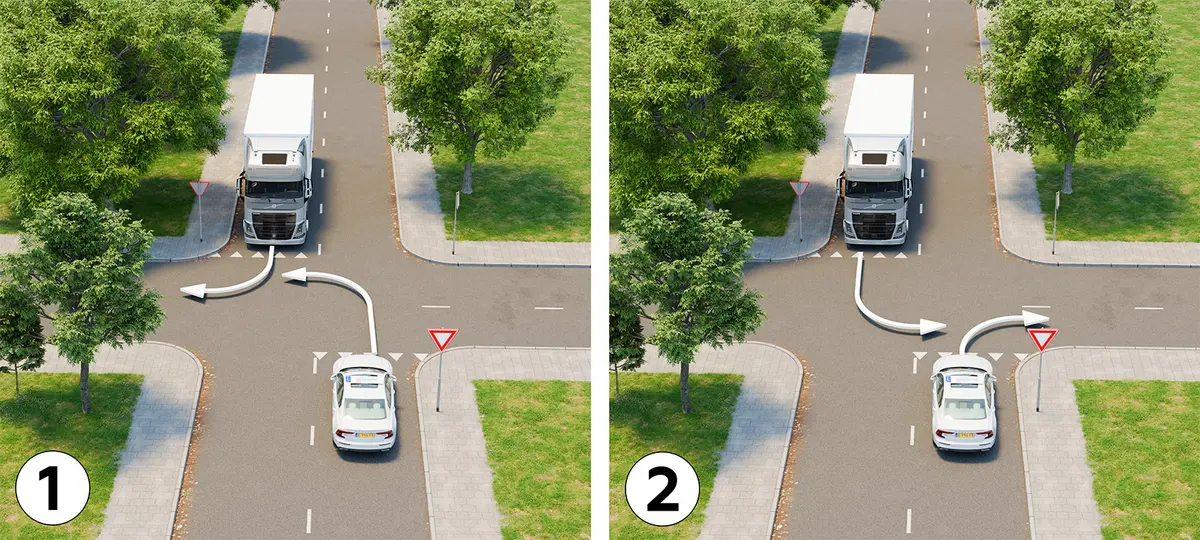
Example: when should you let the truck go first?
A common theory exam question shows a situation where both you and a truck have shark teeth road markings.
Because both vehicles have shark teeth, you can cancel them out against each other. Then you look at which rule applies next.
If the truck makes the short turn and you make the long turn, the truck has priority.
If you are not making the same manoeuvre, you determine priority based on the other applicable traffic rules.
Important: a speed bump does not determine priority
Many candidates think that a speed bump affects who has priority. This is not true.
A speed bump is only intended to reduce speed and does not determine who has priority.
If you only see a speed bump without priority signs, shark teeth, or traffic lights, it is still an equal intersection and the normal right-of-way rules apply.
Example situations
Situation 1
There is only a speed bump visible. The other driver approaches from the left.
Because there are no priority signs or shark teeth and the driver is coming from the left, you do not have to give way.
Situation 2
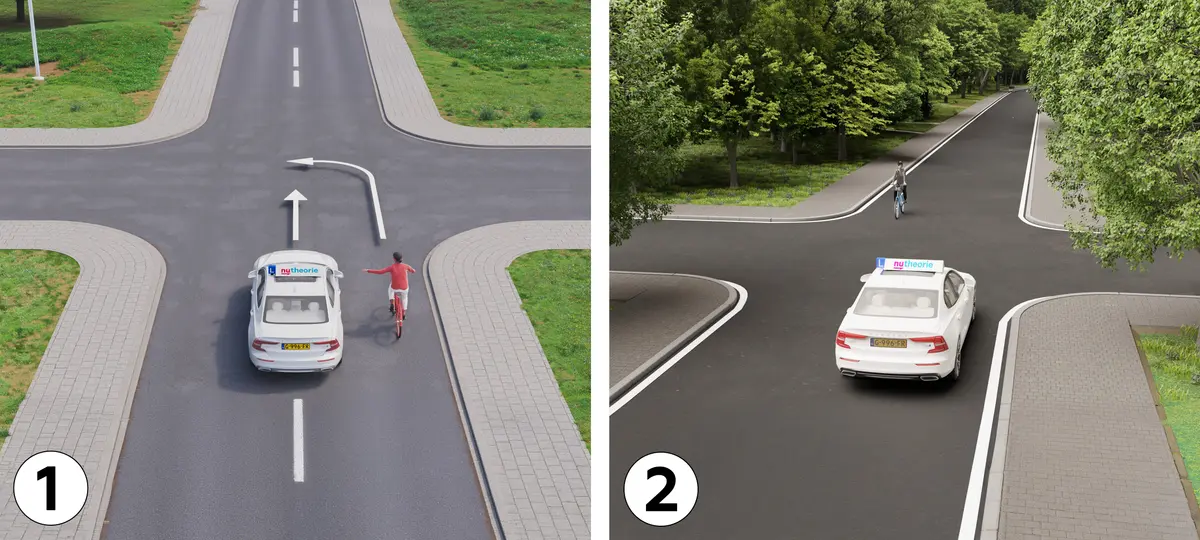
There are still no signs or shark teeth. This time, the other driver approaches from the right.
In this situation, you must give way because the driver coming from the right has priority.
Common mistakes at equal intersections
During the theory exam, candidates often make the following mistakes:
- thinking that a speed bump determines priority;
- forgetting that traffic from the right has priority;
- assuming that driving straight ahead always gives priority, even at an equal intersection;
- applying the "short turn before long turn" rule when drivers are actually crossing each other's paths.
By first checking whether there are priority signs, shark teeth, or traffic lights, you can avoid many mistakes.
Conclusion
At an equal intersection, there are no traffic lights, priority signs, or shark teeth. This means the general right-of-way rules apply. The most important rule is that drivers approaching from the right have priority. When two drivers are travelling on the same road, drivers going straight ahead have priority over turning traffic. If both drivers are turning, the driver making the short turn goes first.
By following this order, you can answer almost every question about equal intersections correctly during the CBR theory exam.


.jpg)