
Overtaking is a fundamental part of driving, but it is also one of the most misunderstood topics on the theory exam. Many candidates know the basic rule but struggle with the exceptions. As a result, questions about overtaking on the right are among the most frequently answered incorrectly.

In this article, you will learn exactly when overtaking on the right is allowed, why these exceptions exist, and how to avoid common mistakes.
The Basic Rule: Always Overtake on the Left
The main rule in traffic is clear: you overtake on the left. This rule creates structure and predictability on the road, which reduces the risk of accidents. Drivers expect to be overtaken on the left, and this expectation is essential for safe traffic flow.
Overtaking on the right is therefore not the norm, but an exception. You should only do it when a specific rule allows it.

Why Exceptions Exist
There are situations where strictly overtaking on the left would actually reduce traffic flow or create unsafe situations. That is why the law includes a number of practical exceptions. These exceptions are designed to keep traffic moving efficiently and safely, especially in complex road situations.
Understanding the reasoning behind these exceptions makes it easier to recognize them during your theory exam.
Situations Where Overtaking on the Right Is Allowed
Block Markings
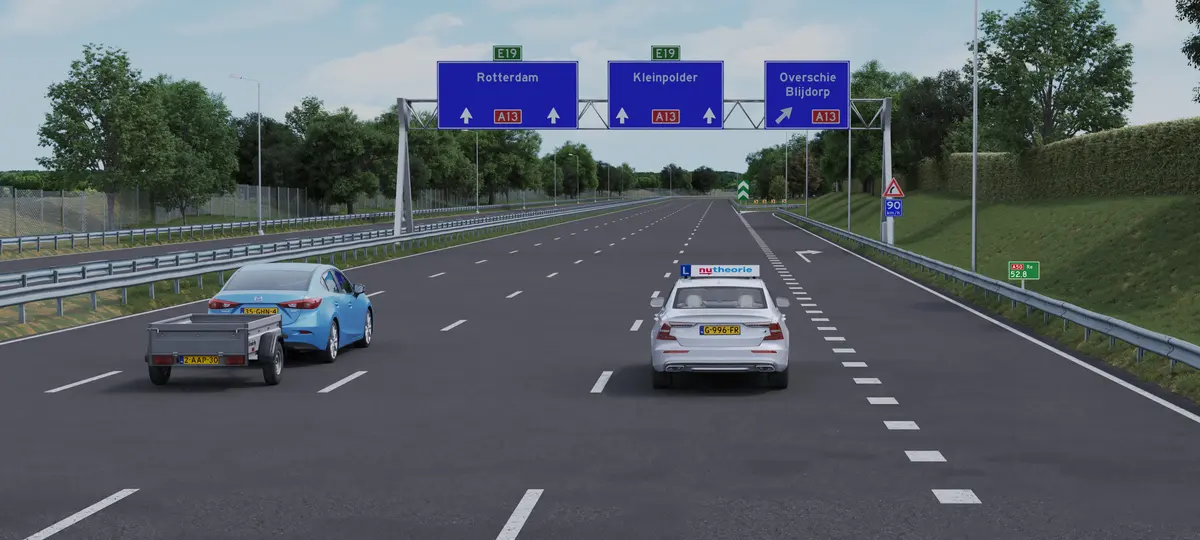
One of the most important exceptions involves block markings. These are white, square markings that separate lanes. You will often see them at merging lanes, exits, or where traffic splits into different directions.
If there is a block marking between your lane and another vehicle, you are allowed to overtake that vehicle on the right. The key detail here is the marking itself. Without it, the rule does not apply.
This is a common exam trap. The presence of multiple lanes alone is not enough. The block marking must be clearly visible.
Traffic Jams and Slow-Moving Traffic
In heavy traffic, vehicles often move slowly or come to a complete stop. In these situations, overtaking on the right is allowed.
This rule exists to improve traffic flow. If drivers were forced to stay strictly in the left lane, congestion would worsen. By allowing vehicles to pass on the right, all lanes can continue moving.
It is important to note that this applies to slow-moving or stationary traffic. At normal speeds, the standard rule of overtaking on the left still applies.
Roundabouts
Roundabouts are designed to allow flexible lane use depending on your direction. For example, if you take a later exit, you may stay in the left lane while other drivers position themselves differently.
Because of this flexibility, overtaking on the right is allowed at roundabouts. Vehicles may pass each other on either side depending on their chosen lane and exit.
For the theory exam, remember that lane choice at a roundabout determines your position, and overtaking rules adapt accordingly.
Overtaking a Tram

A tram usually operates on a dedicated lane that is separated from regular traffic. Because of this separation, drivers are allowed to overtake a tram on the right.
The reasoning is simple: the tram follows a fixed path and does not interact with normal traffic in the same way as cars do. This makes overtaking on the right predictable and safe in this context.
Cyclists follow a similar principle. Since they often use a designated cycle lane, they may also pass other vehicles on the right.
Passing a Vehicle That Is Turning Left
If a vehicle in front of you is clearly positioned to turn left, you are allowed to pass it on the right. This prevents unnecessary delays and keeps traffic flowing.
However, this is only allowed if it is safe to do so. You must always check for oncoming traffic, road markings, and available space before passing.
Common Mistakes on the Theory Exam
Mistaking Lanes for Permission
A very common mistake is assuming that multiple lanes automatically allow overtaking on the right. This is incorrect.
The presence of an extra lane does not change the rule. Only specific conditions, such as block markings or traffic congestion, allow this exception.
Assuming Direction Matters
Some candidates believe that overtaking on the right is allowed if vehicles are heading in different directions, for example at a split in the road.
This is not true. Your intended direction does not determine whether overtaking on the right is allowed. The road markings and traffic situation do.
Using the Cycle Lane
Another frequent mistake is using a cycle lane to overtake on the right. If there is a solid line separating the cycle lane, you are not allowed to drive on it.
This means you cannot use it to pass another vehicle. Even if it seems convenient, it is not permitted and will be marked wrong on the exam.
Misjudging Traffic Conditions
Overtaking on the right in a traffic jam is allowed, but many candidates misinterpret what counts as a traffic jam.
Slow-moving or stationary traffic qualifies. Regular driving speed does not. If traffic is flowing normally, you must still overtake on the left.
Practical Tips for the Exam
Always start by applying the main rule: overtake on the left. Then check if one of the exceptions clearly applies.
Pay close attention to road markings in exam questions. Block markings, solid lines, and lane structures often determine the correct answer.
Take your time to analyze the situation. Many questions are designed to test whether you notice small details.
Conclusion
Overtaking on the right is only allowed in specific situations, such as with block markings, in traffic jams, at roundabouts, when passing a tram, or when a vehicle is turning left.
In all other cases, the standard rule applies: overtake on the left.
A clear understanding of these rules will not only help you pass your theory exam but also make you a safer and more confident driver on the road.