.jpg)

Mobile phones have become an essential part of daily life. Almost everyone carries one everywhere they go. They make life easier in many ways — sending a quick message, checking directions, answering a call, or looking up information within seconds. However, when it comes to phone use in traffic, that convenience can quickly become dangerous.

Many drivers underestimate the risks of using a phone while driving. Even looking at your screen for just a few seconds can lead to serious accidents. In fact, distracted driving caused by mobile phone use is one of the leading causes of traffic accidents worldwide.
So what exactly is allowed when it comes to phone use in traffic? What are the fines? And what do you need to know for your theory exam? In this blog, we explain everything clearly.
Why Phone Use in Traffic Is So Dangerous
Using a phone while driving affects your concentration immediately. The moment your attention shifts from the road to your device, your reaction time becomes slower. This means you may react too late to:
- sudden braking traffic,
- pedestrians crossing,
- cyclists,
- traffic lights changing,
- or unexpected situations on the road.
Many accidents happen because drivers think they can “quickly” read or send a message. But even a few seconds of distraction can have major consequences.
.jpg)
That is why phone use in traffic is taken very seriously during both the theory exam and by the police.
What Is Allowed? Hands-Free Phone Use
The rules regarding phone use in traffic are actually quite simple:
You may only use your phone hands-free while driving.
This means you are not allowed to hold your phone in your hand while participating in traffic. Instead, your phone must be used through a safe system, such as:
- a phone holder,
- Bluetooth connection,
- voice control,
- Apple CarPlay,
- Android Auto,
- or a headset.
Modern cars often include systems like Apple CarPlay and Android Auto, which allow drivers to control calls, navigation, and music through the car’s touchscreen or voice commands. These systems are designed to reduce distraction and make phone use safer.
However, “safer” does not mean “completely safe.”
Even hands-free phone use can still distract drivers mentally.
.jpg)
Theory Exam Question: Which Phone Use Is Allowed?
A common CBR theory exam question asks which methods of answering a phone are allowed while driving.
Examples include:
- using a Bluetooth car kit,
- using a headset,
- or holding the phone in your hand.
The correct answer is:
Bluetooth car kit and headset are allowed.
Holding the phone in your hand is not allowed.
As long as the phone is used completely hands-free, it is permitted in traffic.
Hands-Free Does NOT Mean Risk-Free
Many people believe that hands-free calling is harmless because it is legal. Unfortunately, that is not true.
Even when using a headset or Bluetooth system, your brain is still distracted by the conversation. You are mentally less focused on the road, which affects your awareness and reaction speed.
This is also why another theory exam question is often answered incorrectly:
“Do you react faster when calling with a headset compared to holding a phone?”
The correct answer is:
No.
Whether you hold the phone or use a headset, your attention is still divided. You remain less alert to traffic situations around you.
Fines for Phone Use in Traffic
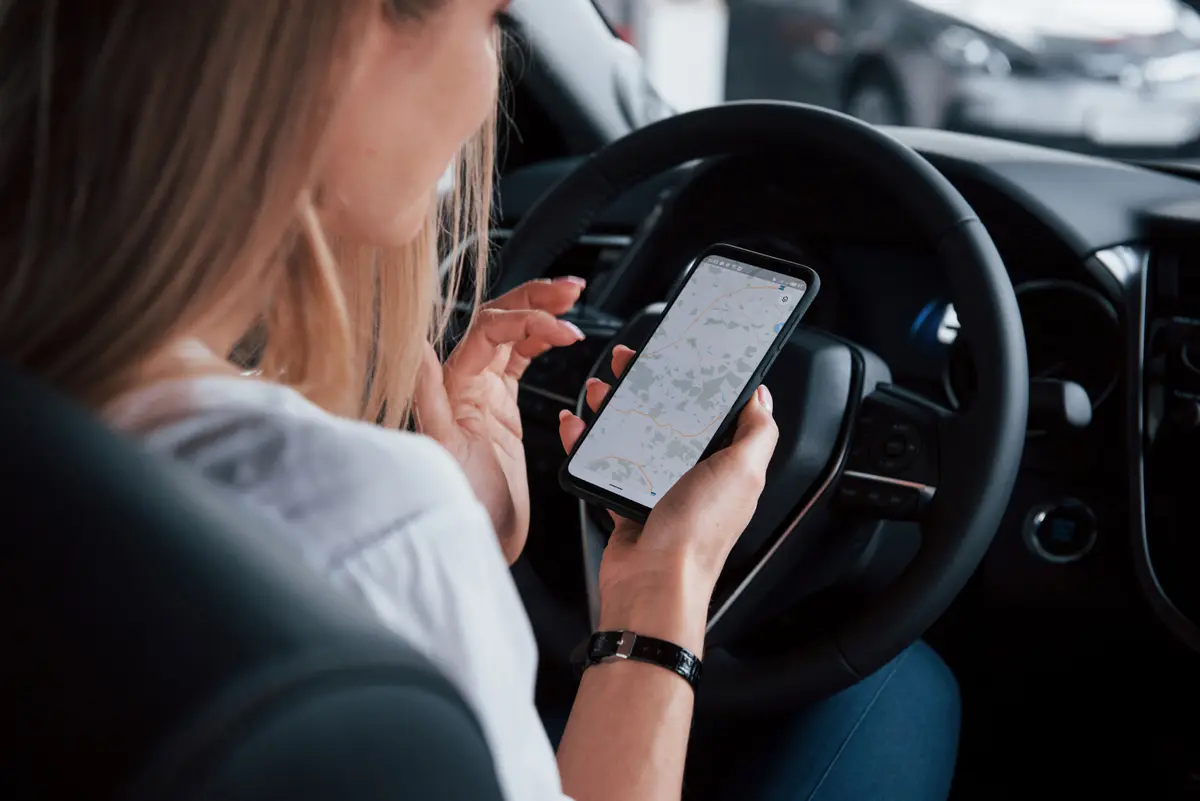
Holding a phone while driving can result in a significant fine.
The fines in 2026 are:
- Cars: €440 + €9 administrative costs
- Mopeds and scooters: €300
- Bicycles: €170
Many people are surprised to learn that cyclists can also receive fines for phone use in traffic. However, distracted cycling can also create dangerous situations for both the cyclist and others on the road.
Can You Use Your Phone While Stopped?
This is where many people become confused.
If you want to hold your phone to answer a message or scroll through notifications, you must make sure you are parked safely.
There is an important difference between:
- stopping,
- and parking.
Stopping
Stopping is only allowed briefly for:
- letting passengers enter or leave the vehicle,
- loading or unloading goods.
Parking
If you stop for any other reason — including using your phone — it is considered parking.
This means you must follow all parking rules and regulations.
What About Traffic Lights or Traffic Jams?
In real life, some drivers briefly hold their phone while standing still at a red traffic light or during a traffic jam. Although this is sometimes tolerated, it is officially still not allowed.
According to traffic rules, you are still participating in traffic even when temporarily stationary. This means holding your phone can still result in a fine.
Ultimately, it remains your own responsibility.
Phone Use in Traffic and the Theory Exam
Phone use in traffic is a topic that appears regularly on the CBR theory exam. Many students make mistakes because they misunderstand the difference between:
- legal phone use,
- safe phone use,
- stopping,
- and parking.
Understanding these rules properly will not only help you pass your theory exam but will also make you a safer driver in everyday traffic.
Final Tips to Avoid Dangerous Situations
To stay safe in traffic:
- Put your phone away before driving.
- Use navigation before starting your journey.
- Enable hands-free systems if necessary.
- Avoid texting while driving.
- Park safely if you need to use your phone.
A message can wait. Your safety cannot.
.jpg)
Prepare for Your CBR Theory Exam Successfully
Do you want to make sure you are fully prepared for the CBR theory exam?
Register for a one-day theory course or an online theory course and improve your chances of passing quickly and confidently. During the lessons, you can ask questions, practice realistic exam situations, and learn useful tips that help you avoid common mistakes.
At CBR theory topics such as phone use in traffic are tested regularly — so good preparation truly makes the difference.
At Nutheorie, students learn traffic rules in a simple and practical way, helping them become confident and safe road users.

.jpg)