
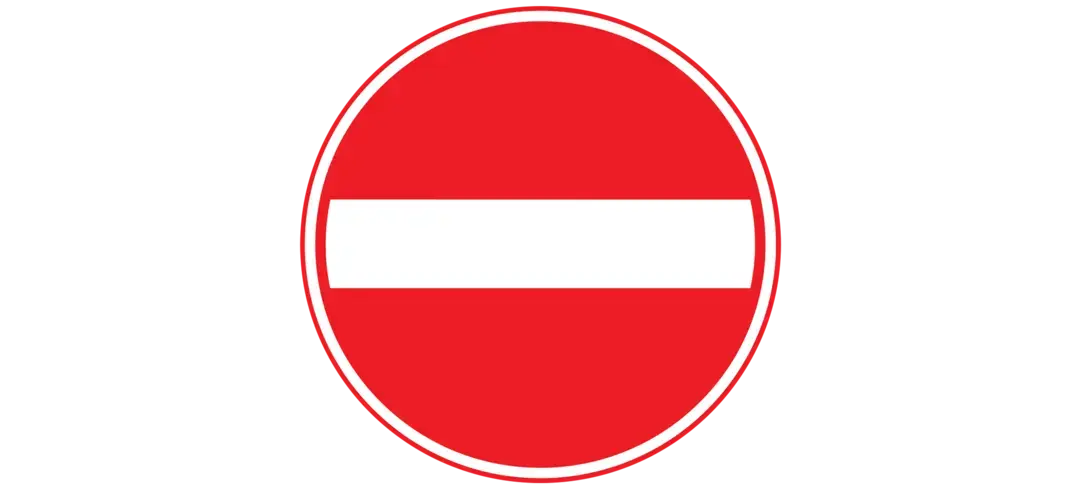
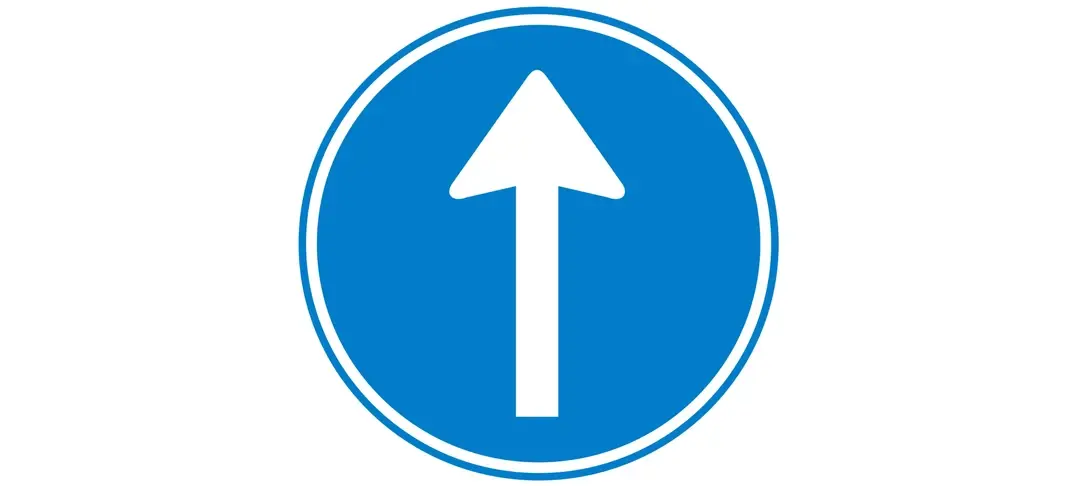
On a one-way street all traffic travels in the same direction. You recognise it by the round red sign with a white bar on the closed side, and the blue sign with a white arrow on the side you may enter. Parking on the left is allowed here, unlike on an ordinary road.

The two signs belong together and always sit in the same street.
The signs that mark a one-way street
Sign C2 is round and red with a white horizontal bar. People call it the no entry sign. Its official name is one-way street, closed in this direction.
Sign C3 is blue with a white arrow pointing up. It stands at the other end of the same street and means you may enter here, in the direction of the arrow.
Sign C4 is the version with the arrow pointing sideways. It faces the side road at a T-junction and shows that the through road is one-way.
The difference from sign C1
Sign C1 is also round and red, but with a plain white centre and no bar. That means the road is closed in both directions.
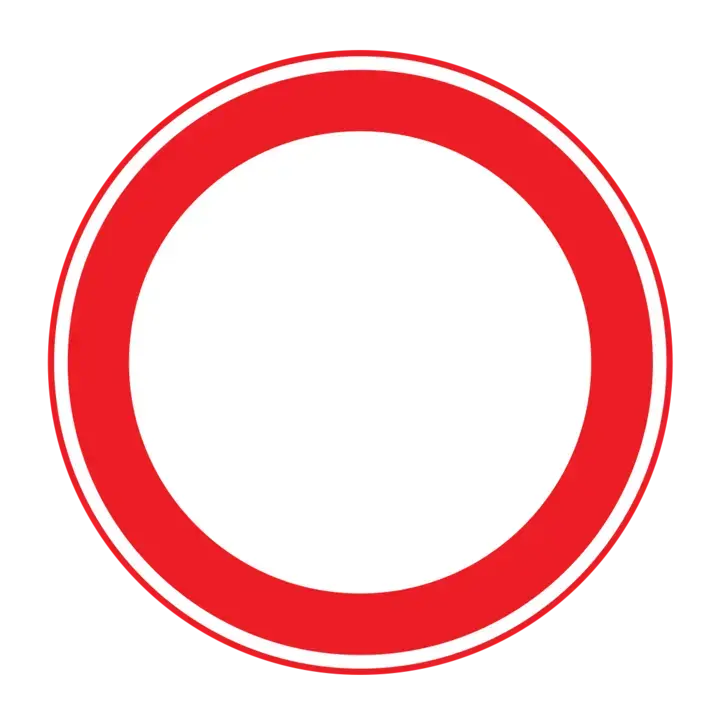
With C1 the same sign stands at both ends. With C2 there is a blue sign at the far end, because the street is only closed from your side.
Mixing these two up is one of the most common theory exam mistakes. Remember it by the bar: a bar means one direction, no bar means closed entirely.
One-way street or compulsory direction?
A one-way street is about the whole road: all traffic goes the same way. The blue D signs are about your movement at that point, such as straight ahead only or right turn only.
So a D sign can stand on an ordinary two-way road. A C3 or C4 tells you something about the street you are entering.
Both have the same consequence though: you cannot turn around, because that would put you facing the wrong way.
Except cyclists
Sign C2 often carries a supplementary plate reading uitgezonderd fietsers, meaning except cyclists. This is called beperkt eenrichtingsverkeer, limited one-way traffic.
Cyclists may then ride both ways while you may not. In such a street, expect someone coming towards you even though you see a one-way sign.
Pedestrians are never covered by these signs. C1 and C2 apply to vehicles, riders and livestock, not to people on foot.
Parking on a one-way street
Here you may park on both sides of the road, including the left. There is no oncoming traffic to obstruct.
On an ordinary two-way road you park on the right. That difference is a classic exam question.
The usual parking bans still apply. Think of a yellow line, a pedestrian crossing or a bus stop.
Turning around and reversing
Turning around on a one-way street gets you nowhere: you would then be driving against the permitted direction. Carry on to the end of the street and turn there.
Reversing as part of a manoeuvre is fine, for example when parking. What you may not do is reverse back down the street to get out.
The mistakes drivers make most often
- Confusing C1 and C2 on the theory exam
- Assuming a one-way street applies to cyclists when a plate exempts them
- Parking on the left of a two-way road after mistaking it for one-way
- Turning around to get back instead of driving on to the end of the street
- Looking only one way when pulling out, while an exempted cyclist approaches
- -Not reading the arrow on the blue sign and still driving the wrong way
What to do if you enter the wrong way
Stay calm and drive on until you can turn safely in a car park or side street. Do not stop abruptly and do not reverse out of the street.
Switch on your hazard lights if you have to drive slowly. That warns the traffic coming towards you.
Along motorway exit ramps you will see sign C2 with a plate reading ga terug, go back. The sign is repeated after at least 100 metres, specifically to prevent wrong-way driving.


.jpg)