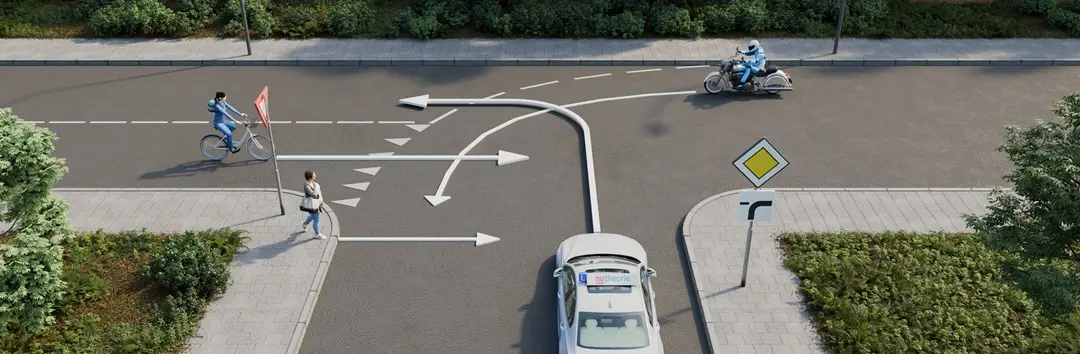

Right of way rules decide who gets to go first. They look simple, but on the CBR theory exam the exceptions are exactly where most people slip up. In this overview we put all Dutch right of way rules (voorrangsregels) in one place: first the order in which you apply them, then the three basic rules and finally every exception you need to know.

What does having right of way mean?
Having right of way means you may go first. A driver who has to give way must not force you to brake or swerve. Right of way is different from letting someone go first: right of way is set in Dutch law (RVV 1990), while letting someone go is something you do for safety or courtesy. Want to know exactly what is expected of you? Also read our article on giving way.
In what order do the right of way rules apply?
Not every rule carries the same weight. Always check in this order:
- Instructions from a traffic controller or the police. These always come first, even if a traffic light says something else.
- Traffic lights.
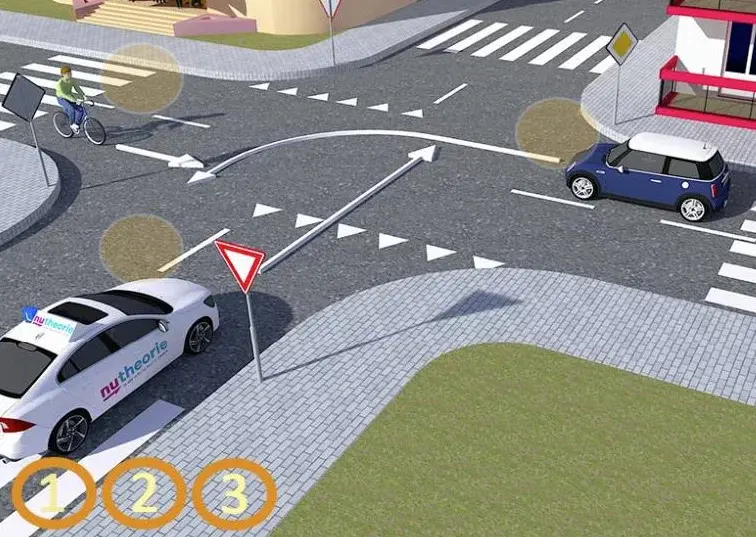
- Traffic signs and road markings, such as shark teeth.
- The general traffic rules, such as traffic from the right goes first.
Is the traffic light flashing amber or switched off? Then the signs and markings apply again. No signs or markings either? Then you fall back on the basic rules below.
The three basic rules
1. Traffic from the right goes first
At an equal intersection you give way to drivers coming from the right. An intersection is equal when there are no signs, markings or traffic lights, or when everyone has the same signs. Cyclists and moped riders are drivers too, so a cyclist from the right goes before you. Pedestrians are not drivers, so this rule does not apply to them. You can find more examples in our article on equal intersections.
2. Straight ahead on the same road goes before turning traffic
Are you on the same road and do you want to turn? Then you let traffic going straight ahead go first. This also applies to cyclists on a cycle path next to the road and to pedestrians crossing the road you are turning into. Note: this rule only applies to traffic on the same road. If someone comes from the right out of a side road, rule 1 comes first.
3. Short turn before long turn
Are you both turning off the same road and coming from opposite directions? Then the driver making the short turn (right) goes before the driver making the long turn (left). If the oncoming driver turns right and you turn left, you wait.
Right of way set by signs and shark teeth
Signs and markings always come before the basic rules. Make sure you recognise these straight away:
- Priority road (orange and white diamond, sign B1): you have right of way over traffic from side roads, until the end of priority road sign (B2).
- Priority intersection (signs B3, B4 and B5): you only have right of way at the next intersection. Read more about the priority intersection.
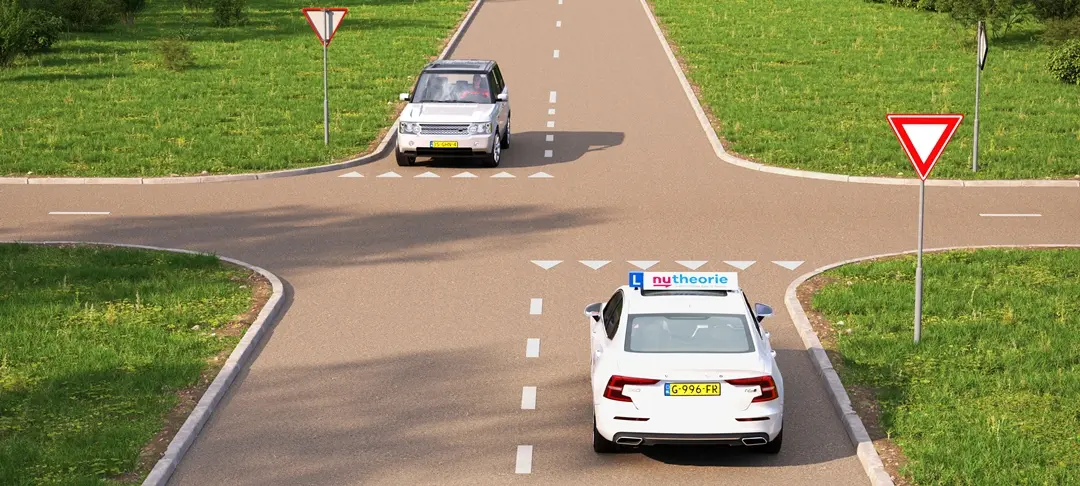
- Give way (upside down triangle, sign B6): you give way to drivers on the crossing road.
- Stop sign (B7): you come to a full stop and then give way.
- Shark teeth: these mean the same as sign B6.
Signs and markings apply to drivers, not to pedestrians. All signs are explained in our article on traffic signs.
Exceptions you need to know
Unpaved road
Coming from an unpaved road, such as a sand road, onto a paved road? Then you give way to all drivers on the paved road, even when they come from the left.
Exit and residential zone
When you drive out of an exit (uitrit) or a residential zone (erf), you let all traffic go first: drivers and pedestrians. You recognise an exit by its construction: the pavement or cycle path continues across, often with a lowered kerb.
Special manoeuvres
Pulling away from a parking space, making a U-turn and reversing are special manoeuvres. You then let all other traffic go first. Also read where you can and cannot make a U-turn.
Trams
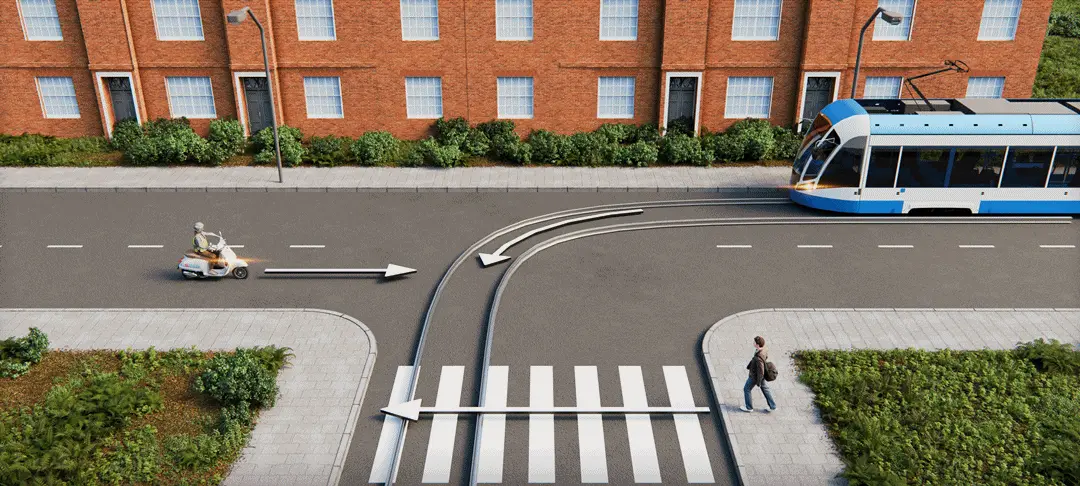
At an equal intersection the tram has right of way, even when it comes from the left. When a tram turns, traffic going straight ahead on the same road lets it go first. If there are signs or shark teeth facing the tram, the tram must follow them too. Everything about trams is in tram right of way rules.
Buses
Inside built-up areas you let a public bus go first when it signals with its indicator that it wants to pull away from a bus stop. Outside built-up areas the bus waits. More in when does a bus have right of way.
Emergency vehicles
Police, fire and ambulance vehicles with a blue flashing light and a siren are priority vehicles. You give them free passage straight away, as soon as it is safe. Read how in making way for an emergency vehicle.
Military convoy and funeral procession
You may not interrupt a military convoy or a funeral procession. Wait calmly until the whole procession has passed.
Pedestrians
Pedestrians are not drivers, so most right of way rules do not apply to them. Still, you let them go first in these situations:
- on a zebra crossing;
- when you turn and they are crossing the road you are turning into;
- when you come out of an exit or residential zone;
- when someone is blind and shows this with a white cane or guide dog.
Why this goes wrong so often on the exam is explained in right of way for pedestrians.
Right of way at a roundabout
Almost every Dutch roundabout has shark teeth and a give way sign. In that case traffic on the roundabout has right of way. Are there no signs or markings? Then the normal rule applies: traffic from the right goes first. When you leave the roundabout, check the signs and shark teeth at the cycle path. They decide whether cyclists have right of way.
How to answer a right of way question on the exam
Use the same step by step plan for every question:
- Is there a traffic controller or a working traffic light?
- Which signs and shark teeth do you see?
- Is the intersection equal? Check who comes from the right, and watch for a tram or an unpaved road.
- Are you on the same road? Straight ahead goes before turning traffic.
- Are you both turning? Short turn before long turn.
You can find a worked example in who has right of way? Handy tricks to remember it all are in our memory aids.
Practise with real exam situations
You only truly master the right of way rules when you can apply them quickly. So practise with our CBR practice exams or learn everything in one day with our English theory courses. Prefer to study at home at your own pace? Our online course has you covered.